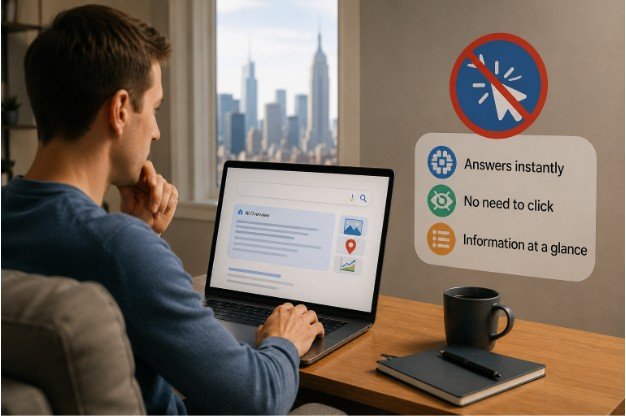
Search has quietly changed over the last couple of years. People still type questions into Google, but they’re getting answers without leaving the search results page more often than ever. Whether it’s an AI Overview, a featured snippet, or a knowledge panel, users can usually find the information they need within seconds. For publishers, marketers, and businesses, that shift has created a new challenge.
That doesn’t mean SEO is disappearing. It means the goal is changing. Instead of treating every search like an opportunity to earn a click, successful brands are focusing on visibility, credibility, and authority. Understanding zero-click search is no longer optional if you want your content to stay relevant in 2026.
What Is Zero Click Search?

Zero click search happens when someone performs a search but never visits a website because the answer is already available on the search engine results page (SERP). AI Overviews, featured snippets, local packs, calculators, weather cards, and knowledge panels all contribute to these searches.
Recent studies suggest that more than half of Google searches now end without a click, and AI-powered search experiences continue accelerating that trend. Users appreciate faster answers, while search engines aim to keep them engaged within their own platforms.
For content creators, this changes how success should be measured. Ranking first is still valuable, but appearing as the trusted source behind an answer has become equally important.
Why Zero Click Search Is Growing So Quickly
The rise of AI search has dramatically changed how information is delivered. Instead of presenting ten blue links, search engines increasingly summarize multiple sources into a single response.
People have also become accustomed to conversational search. Rather than searching with short keywords, users ask complete questions and expect direct answers. AI systems are designed to satisfy that expectation immediately.
This evolution means search engines are becoming answer engines. Content that clearly explains a topic has a much better chance of being surfaced than content written only to rank for keywords.
Why Your Content Strategy Needs to Change

Traditional SEO focused heavily on increasing organic traffic. While traffic still matters, it shouldn’t be the only goal anymore.
Visibility across the search ecosystem now carries equal weight. If your brand is consistently referenced in AI-generated responses, featured snippets, and other SERP features, you’re building recognition even when users don’t immediately click through.
That recognition influences future purchasing decisions, branded searches, and long-term trust. Many users discover a brand through AI search before returning later to learn more or make a purchase.
Write Content That AI Can Understand
AI models look for content that’s easy to interpret. Pages with clear structure, direct answers, and logical organization are more likely to be referenced.
Start by answering the primary question within the first few paragraphs. Then expand on the topic with descriptive headings that cover related questions and supporting details.
Technical optimization also matters. Proper schema markup, including Article, FAQ, and How To schema where appropriate, helps search engines understand your content more effectively. Clean formatting and organized information improve both human readability and machine interpretation.
Original Content Is Becoming Your Biggest Advantage

Basic definitions and generic how-to articles are increasingly being summarized directly inside search results. That makes it harder for commodity content to attract visitors.
The content that still earns clicks usually offers something AI cannot easily recreate. Original research, first-hand experience, expert interviews, industry case studies, proprietary data, and unique opinions provide value beyond a simple summary.
Instead of asking, “Can AI answer this?” ask, “Can AI replace this?” If the answer is yes, the content probably needs a stronger point of view.
Measure More Than Organic Traffic
Website sessions have traditionally been one of the biggest SEO success metrics. In a zero-click environment, they tell only part of the story.
Modern content teams increasingly monitor:
- Search impressions
- AI Overview citations
- Featured snippet visibility
- Brand mentions
- Branded search growth
- Engagement after users arrive
Interestingly, the visitors who still click often have stronger intent because they’re looking for deeper insights than AI can provide. That usually results in higher-quality traffic and better conversion opportunities.
Build an Audience You Actually Own

Search engines will continue evolving, and businesses have little control over those changes. That’s why relying entirely on Google has become increasingly risky.
Email newsletters, private communities, podcasts, webinars, and mobile apps create direct relationships that aren’t affected by search algorithm updates. Every visitor who joins an owned channel becomes less dependent on future search fluctuations.
This is also where building trust before growing your audience becomes especially important. People subscribe, return, and recommend brands they genuinely trust—not simply the ones they discover first in search results.
Focus on Authority Instead of Algorithms
Search engines have become much better at identifying expertise and rewarding genuinely helpful content.
Instead of publishing dozens of shallow articles targeting slight keyword variations, create comprehensive resources that answer real questions thoroughly. Support claims with credible sources, practical examples, and clear explanations.
Topical authority grows over time when multiple high-quality articles demonstrate consistent expertise within a subject. That authority helps both search engines and readers recognize your brand as a reliable source.
FAQs: What Zero Click Search Means for Your Content Strategy in 2026
What is zero click search?
Zero click search occurs when users get the information they need directly from the search results page through AI Overviews, featured snippets, or other SERP features without visiting a website.
Does zero click search mean SEO is dead?
No. SEO is evolving. Visibility, authority, and brand recognition now matter alongside organic traffic, making quality content even more valuable.
How can websites still attract visitors?
Publishing original research, expert insights, case studies, and interactive content gives users reasons to click beyond basic AI-generated summaries.
What should businesses measure in 2026?
Track impressions, AI citations, branded searches, SERP visibility, engagement, and conversions in addition to traditional organic traffic metrics for a more complete performance picture.
Why Visibility Is Becoming More Valuable Than Clicks
The future of search isn’t about competing with AI—it’s about creating content AI wants to reference while giving readers a reason to learn more. Brands that invest in expertise, originality, and genuine value will continue earning attention even as search behavior changes.
Clicks may become fewer, but trust, authority, and meaningful engagement will matter far more than ever before.